General principles · Free article
Local flap geometry: Z-plasty, rhomboid, bilobed and rotation flaps
Local flap design for FRCS (Plast): Z-plasty angles and gains, Limberg and Dufourmentel rhomboids, Zitelli bilobed, rotation, V–Y, keystone and forehead flaps.
Rules that apply to every local flap
A local flap works when it borrows skin from where there is laxity and leaves its scars where they hide. Find the lines of maximal extensibility (LME), which run perpendicular to the relaxed skin tension lines, and orientate the donor closure along them; place final scars in relaxed skin tension lines or at aesthetic subunit junctions; and keep tension off free margins — eyelid, lip, alar rim — which distort long before a wound gapes.
Two mechanical facts recur. A pivoting flap loses effective length as it turns, so it must be drawn longer than it looks as if it needs to be. And every pivot raises a standing cone (dog-ear) of redundant skin, which is removed as a Burow's triangle.
Z-plasty
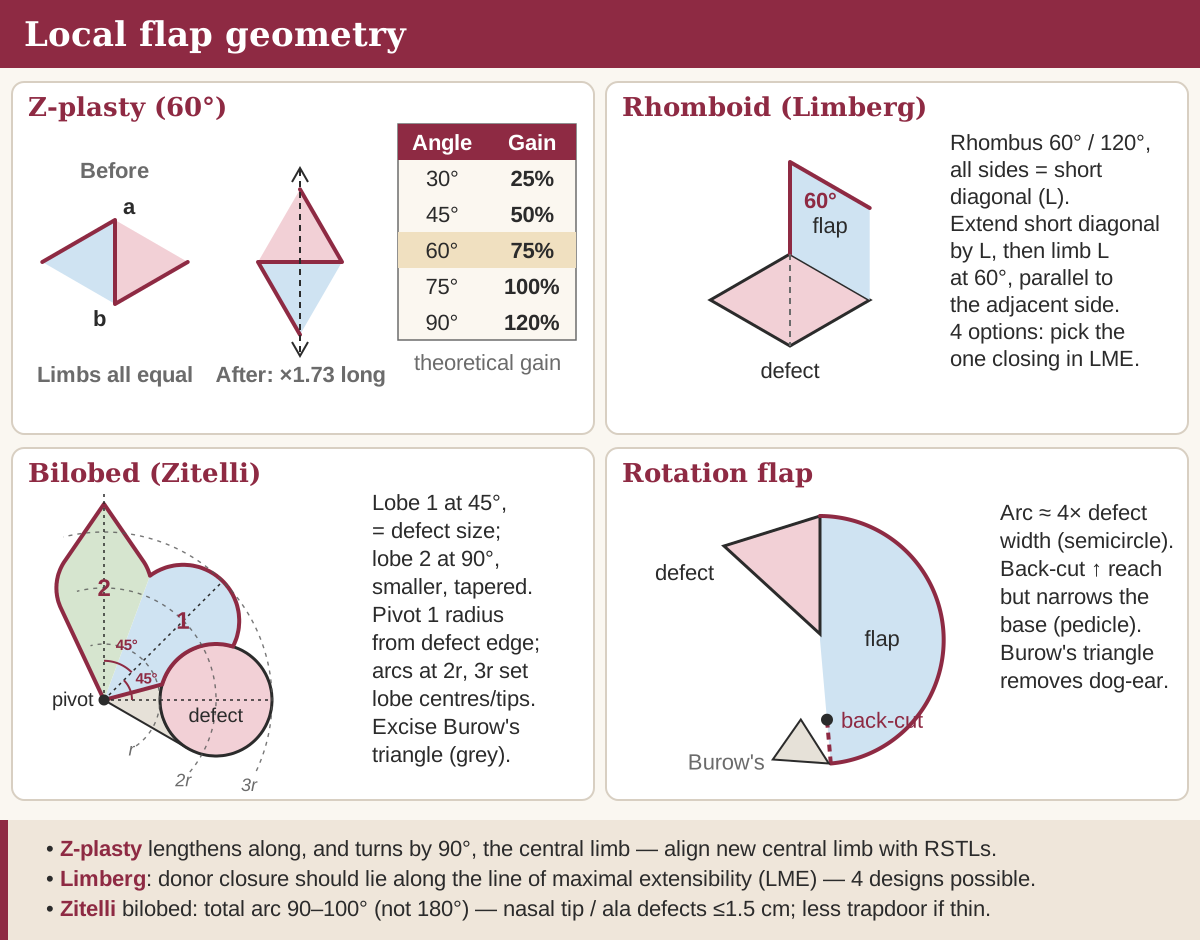
A Z-plasty transposes two equal triangular flaps across a central limb and does three things: it lengthens along the line of the central limb, rotates that limb through 90°, and breaks a straight scar into a less conspicuous zigzag. All three limbs must be the same length; the angle between the central and lateral limbs sets the gain.
| Angle | Theoretical gain in length |
|---|---|
| 30° | 25% |
| 45° | 50% |
| 60° | 75% |
| 75° | 100% |
| 90° | 120% |
The 60° design is standard because it balances gain against the tension needed to transpose the flaps: beyond 60° the flaps resist transposition and lateral tightness climbs steeply; below about 30° the narrow tips risk necrosis and the gain is trivial. After a 60° transposition the distance along the original axis is about 1.73 times the original central limb.
- Serial (multiple) Z-plasties break one long central limb into a chain of small Zs. The theoretical total gain matches one large Z of the same length, but each flap is smaller and lateral tension is shared — useful when surrounding skin is scarred.
- Four-flap Z-plasty bisects each flap of a 90° Z into two 45° flaps, giving a large gain with a smooth curve — a classic release for a first web space contracture.
- Five-flap Z-plasty (‘jumping man’) pairs two opposing Z-plasties with a central V–Y advancement to deepen a web or release an epicanthic fold.
- Double-opposing Z-plasty (Furlow) lengthens the soft palate and realigns the levator sling in cleft palate repair.
Rhomboid (Limberg) and Dufourmentel flaps
The Limberg flap closes a rhombus with 60° and 120° angles whose four sides all equal the short diagonal. Extend the short diagonal beyond a 120° corner by its own length, then draw a second limb of the same length at 60°, parallel to the adjacent side of the rhombus. The flap transposes into the defect and the donor site closes directly.
Every rhombus offers four designs — two from each end of the short diagonal. Choose the one whose donor closure lies along the lines of maximal extensibility, because closing the donor site is where tension concentrates, and reject any design that pulls on a free margin. The Dufourmentel modification suits rhombi with acute angles between 60° and 90°: the first limb bisects the angle between the extended short diagonal and the extended adjacent side, and the second runs parallel to the long diagonal. The broader base needs less rotation.
Bilobed flap (Zitelli)
The bilobed flap is a double transposition flap: a primary lobe fills the defect, a smaller secondary lobe fills the primary donor site, and the final donor site closes directly in lax skin. Esser's original design rotated each lobe through about 90°, which produced large standing cones and trapdoor deformity; Zitelli limited each lobe to about 45–50°, for a total arc of roughly 90–100°.
- Primary lobe matches the defect in diameter, or is very slightly smaller.
- Secondary lobe is smaller and tapered to a point so its donor site closes as a line.
- Pivot point sits one defect radius from the defect edge. Concentric arcs from it — one through the centre of the defect, one through its far edge — set the bases and tips of the lobes.
- Burow's triangle between the pivot and the defect is excised to remove the standing cone.
Its home is the lower third of the nose — tip and ala — for defects up to about 1.5 cm where the upper nasal skin is mobile enough to donate. Keep the design clear of the alar rim to avoid notching, and undermine widely just above the perichondrium and periosteum to limit pincushioning.
Rotation flaps
A rotation flap is a semicircle of tissue that swings about a pivot point into an adjacent triangular defect, so the defect is drawn as part of the circle. The arc must be long: quoted figures range from about four times the defect width for a simple semicircle to five to eight times in some texts, and the practical message is that a rotation flap is always far larger than the hole it closes.
Tension is greatest along the line from the pivot point to the far edge of the defect. A back-cut into the base at the pivot adds reach but narrows the pedicle, so use it sparingly; excising a Burow's triangle along the outer side of the base equalises the wound edges and removes the dog-ear. Rotation flaps suit the scalp (often several together), the cheek (Mustardé for lower eyelid defects) and the sacrum (gluteal rotation for pressure sores).
Advancement: V–Y and keystone
Advancement flaps move straight forward with no rotation, so their reach depends on skin elasticity rather than geometry. A rectangular flap needs Burow's triangles at its base; in a V–Y advancement, a V-shaped island on a subcutaneous pedicle slides into the defect and the donor site closes behind it as the stem of a Y. The V–Y underpins the Atasoy volar and Kutler lateral fingertip flaps and many facial and pressure sore designs.
Behan's keystone design perforator island flap is a curvilinear trapezium — in effect two V–Y advancements joined end to end — drawn alongside an elliptical defect, matching its width, with each end angled at about 90°. It is islanded on the underlying perforators, advanced, and closed as V–Ys at each end. Behan described four types, from simple direct closure through fascial release and grafting of the secondary defect to double-opposed and rotated variants.
Interpolation: forehead and nasolabial flaps
An interpolation flap crosses intact skin to reach a nearby but non-adjacent defect, so its pedicle is divided at a second stage, usually around three weeks. The paramedian forehead flap is axial on the supratrochlear vessels and is the standard for large or multi-subunit nasal defects; the superiorly based nasolabial interpolation flap is a strong option for the ala. Both are planned to Burget and Menick's subunit principle — if more than half of a subunit is lost, replace the whole subunit.
| Flap | Movement | Key geometry |
|---|---|---|
| Z-plasty | Double transposition | Equal limbs; 60° gives about 75% gain |
| Limberg rhomboid | Transposition | 60°/120°; sides equal the short diagonal |
| Bilobed (Zitelli) | Double transposition | 45–50° per lobe; 90–100° total |
| Rotation | Rotation | Long arc; back-cut and Burow's triangle |
| Keystone | Advancement (island) | Width equals defect; ends at about 90° |
| Paramedian forehead | Interpolation | Supratrochlear axis; division at about 3 weeks |
Frequently asked questions
How much length does a 60° Z-plasty gain?
About 75% in theory along the line of the central limb, which also rotates through 90°. Real gain is less and depends on how lax the surrounding skin is.
Why is 60° the standard Z-plasty angle?
It is the best compromise. Larger angles gain more on paper but the flaps become hard to transpose and lateral tension rises steeply; smaller angles gain little and risk tip necrosis.
How do I choose between the four rhomboid flap options?
Pick the one whose donor-site closure runs along the lines of maximal extensibility, because that closure carries the most tension. Avoid any design that pulls on a free margin such as the eyelid or lip.
What did Zitelli change in the bilobed flap?
He reduced rotation from about 90° per lobe to about 45–50°, for a total of 90–100°, and excised a Burow's triangle at the pivot. This reduces standing cones and trapdoor deformity on the nose.
When is a forehead flap better than a bilobed flap?
When the nasal defect is beyond roughly 1.5 cm, spans several subunits, or the remaining nasal skin is too tight to donate. The bilobed flap is for small lower-third defects with mobile upper nasal skin.
References
- Janis JE (ed). Essentials of Plastic Surgery, 3rd ed. Thieme — chapters on local flaps and Z-plasty.
- Richards AM, Dafydd H. Key Notes on Plastic Surgery, 2nd ed. Wiley-Blackwell — Flaps.
- Chung KC (ed). Grabb and Smith's Plastic Surgery, 8th ed. Wolters Kluwer — chapters on local flaps and nasal reconstruction.
- Zitelli JA. The bilobed flap for nasal reconstruction. Arch Dermatol, 1989.
- Behan FC. The keystone design perforator island flap in reconstructive surgery. ANZ J Surg, 2003.
- Burget GC, Menick FJ. The subunit principle in nasal reconstruction. Plast Reconstr Surg, 1985.
Further reading
- Z-Plasty: Designs, Indications, Variations — thePlasticsFella — Independent open-access resource
- Transposition Flap — thePlasticsFella — Independent open-access resource
- Rotation Flap — thePlasticsFella — Independent open-access resource
- Bilobed Flaps — thePlasticsFella — Independent open-access resource
Written for revision in the FRCS (Plast) style under our editorial standards. It is not clinical advice: always confirm against current guidance. Spotted an error? Tell us.
Related articles
General principles
Flap classification: blood supply, tissue and movement
Flap classification for FRCS (Plast): random vs axial, Mathes–Nahai types I–V, Cormack–Lamberty A–D, Nakajima, movement and Gent perforator nomenclature.
ReadGeneral principles
Angiosomes, perforasomes and the delay phenomenon
Taylor's angiosomes, choke vessels, Saint-Cyr's perforasomes, direct and indirect perforators, delay, supercharging and flap monitoring for FRCS (Plast).
ReadGeneral principles
Skin graft take: thickness, phases and failure
Skin grafts for FRCS (Plast): split vs full thickness, contraction, phases of take, recipient beds, causes of failure, meshing ratios, bolsters and NPWT.
ReadTurn reading into marks
Drill general principles with curriculum-mapped questions, rate your confidence, and watch the gap close on your dashboard.